Header Logo
  • Reflux / Heartburn
    • Acid Reflux / Heartburn
    • GERDX
    • The EsophyX TIF Procedure
    • Stretta
    • GERD Treatment Options
    • BARRX Ablation Procedure
      • Treating Barrett's Esophagus
  • Abdominal Pain
    • Gastritis / Helicobacter Pylori
    • Peptic Ulcer Disease
  • IBS / Constipation
    • Irritable Bowel Syndrome
    • Constipation
    • Lactose Intolerance
    • Bacterial Overgrowth (SIBO)
    • Fecal Incontinence and Solesta
    • Probiotic Supplements
  • Hemorrhoids
    • Hemorrhoids / CRH Hemorrhoidal Banding
    • Infrared Coagulation
    • Colitis
    • Colon Polyps & Cancer
    • Liver Disorders (e.g. Hepatitis)
  • Weight Loss
    • Overweight Facts
    • Intragastric Balloons for Weight Control
    • Endoscopic Sleeve Gastroplasty
    • Gastric Bypass Failure - Revision & Repair
    • Nutritional & Behavioral Weight Management
    • BMI Calculator
  • Procedures
    • GERDX
    • The EsophyX TIF Procedure
    • Stretta
    • Stomach Balloons for Obesity
    • Endoscopic Suturing for Obesity
    • CRH Hemorrhoidal Banding
    • Colonoscopy
    • Upper Endoscopy
    • BARRX Ablation Procedure
    • Radiation Change Therapy
    • Infrared Coagulation
  • Aesthetics
    • Medical Body Shaping of the Hudson Valley
    • Evolve Body Contouring
    • Facial Tox
  • Store and media
    • Dr. Radio
    • In the News
    • Video Forum
    • Dr. Starpoli's Blog
    • Health Supplements & More

Two Gene Signature-Based Tests May Help Identify Colon Cancer.

By Anthony Starpoli
November 06, 2010
Video examination of the colon

As reported from Medscape (11/4, Canavan) reported, "Two new tests that examine the gene signatures of peripheral blood mononuclear cells have demonstrated high sensitivity in the identification of colorectal cancer (CRC) and adenomas larger than 1 cm." Researchers in Switzerland first zeroed in on "60 markers," and the "resulting panel highlighted the gene signatures of proteins involved in several different biologic functions, including those of cellular movement, cell signaling and interaction, tissue and cellular development, cancer, and cell growth and proliferation." Then, after using that "suite of biomarker candidates" to assess other patients with IBD or "non-CRC cancers," investigators decided on "a final selection of 24 genes [that] was used to create two separate assays. They were designated COLOX CRC for cancer detection, and COLOX POL (polyp) for adenomas."

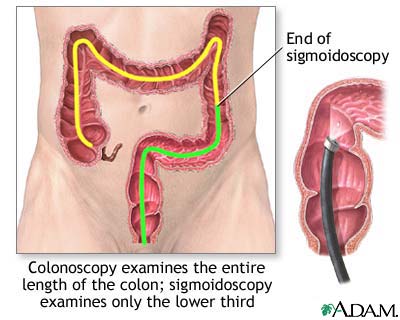
Current methods for colon cancer screening include stool studies for blood, flexible sigmoidoscopy, barium enema, and colonoscopy. Virtual colonoscopy uses CAT scan technology with specialized software to reconstruct images of the colon.  This "virtual colonoscopy" is a fascinating technology, but can not properly image very small polyps and when there is a questionable finding, colonoscopy must be performed.  Therefore, colonoscopy remains the gold-standard for the prevention and diagnosis of colon cancer. Colonoscopy, unlike sigmoidoscopy, allows for examination of the entire colon and not just the left side.  We hope in the future that there will be an easy blood test or stool test that will be definitive in the diagnosis of colorectal cancer, or the finding of early polyp formation. The biggest issues to get people accustomed to the idea of having an exam to manage such a preventable cancer.

The new gene testing for colon cancer and polyps will allow for earlier detection and, perhaps, allow clinicians to risk stratify "at risk" for colon cancer persons well before any manifestations of the disease occur.  Cologuard is a commerical available stool DNA test that can detect colon cancer.

colon cancer colon polyps cancer screening

All posts
You might also like
the-importance-of-getting-a-colonoscopy-to-screen-for-colon-cancer
The Importance of Getting a Colonoscopy to Screen for Colon Cancer
November 06, 2010
noninvasive-colorectal-cancer-tool-shows-unprecedented-detection-rates
Noninvasive Colorectal Cancer Tool Shows Unprecedented Detection Rates
November 06, 2010
causes-of-rectal-bleeding
Causes of Rectal Bleeding
November 06, 2010
Faqs
Ask the Doctor
Patient Portal
Schedule with us
Greenwich Village Gastroenterolog
80 5th Ave. Suite 1605 New York, NY 10011
55 Montgomery St. Poughkeepsie, NY 12601

212 673 2721 845 471 1354
info@starpoli.com

  • facebook
  • instagram
  • twitter
  • linkedin
  • Home
  • Reflux / Heartburn
  • Abdominal pain
  • Hemorrhoids
  • Weight Loss
  • Procedures
  • Facial Tox
  • Dr. Starpoli's Blog
  • IBS
© 2025 AA Starpoli, MD |Office Policies |Privacy Policies