
Have you undergone gastric bypass surgery for obesity and have regained weight or never realized significant loss?


The overweight epidemic is estimated to have afflicted some 1.7 billion people world-wide. Approximately 2/3 of the United States population are overweight (BMI =25) and almost half of this group are obese (BMI =30). About 5% of the U.S. population is morbidly obese (BMI =40 or BMI=35 in association with significant comorbidities).1 Among children aged 6 through 19 (1992-2002), 31% were at risk for becoming overweight and 16.0% were overweight.2 There is a rise in the prevalence of obesity as well as obesity related comorbidities that are responsible for more than 2.5 million deaths annually through out the world.1

Bariatric surgery is indicated for patients with morbid obesity and more than 90,000 obesity surgical procedures were performed on 2003. It is estimated there will be a 3-fold increase in the number of bariatric surgeries by 2008.3

The most popular and effective surgical obesity procedure is the Roux-en-Y gastric bypass (RNYGB) that is both a restrictive procedure, by creating a small gastric pouch, and a malabsorptive reconstruction by way of the creation of a jejunal bypass. Studies show that following RNYGB, weight loss is achieved in amounts of 2/3 of excess weight at 1-2 years post-op, 3/5 at 5 years and more than half in years 5 through 10.4 RNYBG will fail in some 10-15% of patients for a variety of reasons that are likely multifactorial.

Weight regain may very well be related to dietary habits, but it has been suggested that dilation of the gastrojejunostomy (GJ) anastomosis or stoma (the connection point between the stomach pouch and the intestine) may play a role in the loss of the sensation of satiety or the ability to feel full after eating. Many patients loss the sense of fullness and eat more. The gastric pouch may also dilate along with an enlargement of the GJ stoma.5 However, the causal relationship between a dilated gastric pouch and GJ stoma is unknown. The two distinct treatment failure groups include patients with an inability to meet their goal weight with primary RNYGB and those who achieve a 50-60 percent of excess weight loss and then regain weight following surgery. In this latter group, the dilated GJ anastomosis may be contributory to weight regain. The lack of response to gastric bypass anti-obesity surgery is often referred to as post-gastric bypass recidivism.

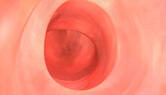
Endoscopic (using a video camera on a tube to look into the stomach through the mouth) assessments of the gastrojejunostomy or stoma (the connection between the gastric pouch and intestine) following RNYGB have shown a correlation between recidivism and GJ diameter.6 The resultant stoma size of the GJ anastomosis (the connection between the gastric pouch and small intestine) following RNYGB surgery is approximately 10-12 mm. GJ diameters greater than 2 cm appear to regain more weight.7 Open, surgical revision of the GJ anastomosis is undesirable because of the inherent surgical risks and the possibility of anastomotic leakage. This observation has lead to attempts at incisionless, endoscopic or endolumenal approaches to reduce the diameter of the GJ anastomosis and restore it to its immediate post-operative size.

Spaulding7 reported the use of endoscopic (through the mouth) sclerotherapy with sodium morrhuate in 20 patients experiencing post-gastric bypass recidivism that achieved a reduction in GJ diameter to 9-10 mm. The average weight loss was 5.8 kg. In a longer follow up (= 12 months) of 32 recidivism patients treated with sclerotherapy for dilated GJ, 56.3% began to lose weight, 34.4% stabilized their weight, and 9.4% continued to gain weight.8

Catalano3 also reported the use of endoscopic sclerosant injections into the dilated GJ stomas of 28 patients who suffered weight gain after an initial loss following RNYGB. Stomal size was reduced to <12mm in 18 of 28 (64%) subjects. A mean of 2.3 sessions were performed with a mean use of 14.5 ml of sodium morrhuate injected in divided doses into four quadrants of the anastomosis. Of the responder group, mean weight loss was 22.3 kg (± 9.2 kg) at 18 months mean follow up. Larger pre-endotherapy stoma diameters seemed to predict failure to sclerotherapy. Stoma diameters in treatment responders decreased from a mean of 16.1 mm before endotherapy to 10.4 mm after endotherapy. The treatment failures had a larger pre-endotherapy mean stoma diameter of 18.7 mm and decreased their diameters to only 16.8 mm after therapy. Post-injection pain occurred in 21 of 28 (75%) in the first 12-24 hours following sclerotherapy.

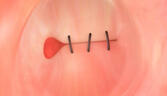
Schweitzer5 reported using a flexible endoscopic suturing device (ESD, Wilson-Cook) to place three sutures across the dilated GJ anastomosis, thereby creating 3 plications, in 4 four Post-RNYGB recidivism patients. All 4 patients had a successful reduction in GJ stomal size. Early on, following stomal size reduction, these patients experienced ‘feeling full’ more quickly and reported weight loss without long-term follow up.
In 2005, Starpoli et al9 conducted a prospective study of GJ anastomotic size reduction in 11 post-RNYGB recidivism patients using the BARD EndoCinch suturing system. Those with endoscopically measured GJ diameters of >15mm underwent gastroplication along the anastomotic ridge, resulting in an average size reduction of 35% or 9 mm (diameter) at a 3 month follow up. The average weight loss recorded per patient was 10 lbs and there were no reported operative complications or morbidity. In the same year results were also reported using the EndoCinch suturing system to reduce the size of the GJ anastomosis in 8 patients who had regained an average of 24 kg from baseline following RNYGB. At 4 months follow up, 6 of 8 patients had lost an average of 10 kg and 4 reported significant improvements in satiety.

In the revolution of natural orifice translumenal endoscopic surgery (NOTES), endolumenal (through the mouth and without incisions) suturing techniques for stomal revision of the dilated GJ anastomosis are examples of the growing capabilities of the gastrointestinal endoscopist. There may be a chance that your poor weight control after gastric bypass surgery may be the result of an expansion or stretching of the connection between the stomach pouch and the intestine. This can be determined by a simple endoscopy and you could be offered a nonsurgical approach to correcting this problem. Of course, sound nutritional advice should be available as well as close follow up with your medical or bariatric physician.


AA Starpoli, MD

Click her for additional information

REFERENCES

1. Buchwald et al. Bariatric Surgery A systematic review and meta-analysis. JAMA 2004; 292: 1724-1737.

2. Hedley AA et al. Prevalence of overweight and obesity among US children, adolescents, and adults. JAMA 2004; 291:2847-2850.

3. Catalano MF et al. Weight gain after bariatric surgery as a result of a large gastric stoma: endotherapy with sodium morrhuate may prevent the need for surgical revision. Gastrointestinal Endoscopy. 2005; 66:240-245

4. DeMaria EJ. Bariatric procedures. Chapters from ACS Surgery. 2005.

5. Schweitzer M. Endoscopic intraluminal suture plication of the gastric pouch and stoma in postoperative Roux-en-Y gastric bypass patients. J Laparoendosc Adv Surg Tech A. 2004 Aug;14(4):223-

6. Negbenebor D.S., Roslin M., Cacciarelli A., Gualtieri N.M., Starpoli A. Endoscopic Assessment of Gastrojejunostomy Size in Post-Gastric Bypass Recidivism Abstract & Poster American College of Gastroenterology October 2004.

7. Spaulding L. Treatment of dilated gastrojejunostomy with sclerotherapy. Obes Surg. 2003;12(2):254-7.

8. Spaulding L et al. Long-term results of sclerotherapy for dilated gastrojejunostomy after gastric bypass. Surg Obes Relat Dis. 2007 Oct 10.

9. Anthony Austin Starpoli, Darlene Sandra Negbenebor, Mitchell S Roslin, Thomas Khouri Haddad, Nicholas M Gualtieri, Grethe Stoa Birketvedt
Prospective Feasibility Study of Gastrojejunostomy Anastomotic Size Reduction by Endoluminal Gastroplication in Patients with Post-Gastric Bypass Recidivism Abstract & Poster T1395 DDW 2005

10 Thompson CT et al. Peroral endoscopic reduction of dilated gastrojejunal anastomosis after Roux-en-Y bypass: possible new option for patients with weight gain. Surgery for Obesity and Related Diseases 2005; 1:223.

Swallowing Difficulty Related and Unrelated to GERD

back to top

Everyone occasionally has heartburn. This occurs when stomach acid flows backward into the esophagus, the food pipe that carries food to the stomach. People usually experience heartburn after meals as a burning sensation or pain behind the breast bone. Often, regurgitation of food and bitter-tasting stomach acid accompanies heartburn. Antacids or milk temporarily relieves heartburn for most people.

Why Does Heartburn Occur?
To understand heartburn, let us look at the body's anatomy. The esophagus carries food and liquid to the stomach. A sphincter, or muscular valve, is located at the end of the esophagus at the border between the esophagus and stomach. Known as the lower esophageal sphincter (LES) this muscle contracts much the same as the anus does. The sphincter should maintain a certain pressure to keep the end of the esophagus closed so that stomach juices are not admitted. The LES muscle should only open when food is passed into the stomach.

However, the LES muscle does not always work perfectly. It is felt that the problem is with inappropriate, transient relaxations of this sphincter valve that result in reflux. Sphincter function can be easily overcome by a number of factors, the most common being eating a large meal. Along with swallowed air, a large meal causes an upward pressure in the stomach to rise, thereby overpowering the LES muscle. Other factors that reduce the LES pressure and allow reflux are:

  • Nicotine (cigarettes)
  • Fried or fatty foods
  • Chocolate
  • Coffee
  • Citrus fruits and juices
  • Peppermint
  • Pregnancy
  • Lying flat
  • Hiatus hernia
  • Certain prescription medications


Swallowing difficulty, medically termed dysphagia, can arise for a variety of reasons.  Firstly, reflux alone can disturb the muscular contraction or motility of the esophagus and interfere with the passage of liquids and solids.  Often, when reflux is controlled, these symptoms will disappear.

The inflammatory response of the esophagus from chronic reflux can lead to the formation of a ring of scar tissue at the end of the esophagus where it meets the stomach, an area know as the gastroesophageal junction (the location of the LES), that can lead to a mechanical obstruction causing difficultywith swallowing solids.  This entity is known as an esophageal ring or a Schatzki Ring.  In some cases the ring needs to be disrupted in order to resolve the blockage.

Of course with chronic reflux comes the risk of esophageal cancer and although the risk is low, it is very real.  Such tumors can cause significant blockage and bleeding.  The cancers are diagnosed most often by way of video upper endoscopy.  A person presenting with new-onset swallowing trouble, a history of reflux, bleeding, and weight loss should seek a medical evaluation immediately.

There are a variety of primary esophageal motility disorders that cause swallowing trouble.  Achalasia is a disorder that can be quite insidious and involves that loss of motility in the body of the esophagus and the lower esophageal sphincter (LES)fails to relax.  The physical presentation can look like reflux because the patient does not clear contents of the esophagus and those materials can backwash into the upper esophagus and mimic GERD. The diagnosis of Achalasia is made by way of esophageal manometry whereby the wave forms  of the esophagus are measured to make the diagnosis.  Achalasia can be treated surgically (laparoscopically) or by balloon dilation of the lower sphincter.

There are other esophageal motility disorders that can be described by esophageal manometry and they include diffuse esophageal spasm that is often associated wit noncardiac chest pain, the Nutcracker esophagus, and Ineffective Esophageal Motility.  Esophageal motility studies ( manometry) will require the passage of a small caliber tube into the esophagus through a nasal passage.  The test takes about 20-30 minutes to complete and is well-tolerated.  It is performed as an out-patient.